Earth Science Today
Russ Colson
Minnesota State University
Moorhead
Historical Geology:
Topic 2: Stratigraphy, plate tectonics, and geological change
Particular rocks and fossils tell us what the Earth was like at one time in the past, a snapshot of Earth at that time. But geologists are not only interested in what things were like at one time, they are interested in how things changed through time. Layers of rock tell stories of change, converting individual snapshots into a motion picture of the Earth as it changes through time. For example, a crinoid-rich limestone may tell us about an ancient ocean, but the sequence of layers of rock types reveal what came before and after that ocean, whether it advanced or retreated for example.
Stratigraphy comprises many of the key tools for reading the
stories of change. Plate tectonics comprises the grand theory
explaining what has caused much of that change.
You can tell a story of the Red River Valley: Most of us have heard that there was once a huge lake in the Red River Valley. But how do we know that, and when was it here? Was the lake here before or after the glaciers? Was it here before or after the dinosaurs?
Here is the stratigraphy beneath our feet in the Red River Valley.
From it, you can read the story of the Red River Valley over the geologically
recent past (the older sediments are listed at the bottom). Discuss
it with someone else and try to read the story before checking the answer
key.
mixture of silts, sands, and plant debris
well sorted clay-rich mud
mixture of silts, sands, and woody tree fossils
well sorted clay-rich mud
poorly sorted mixture of mud, sand, and gravel
well sorted clay-rich mud
poorly sorted mixture of mud, sand, and gravel
(Key to story, est2b3.html)
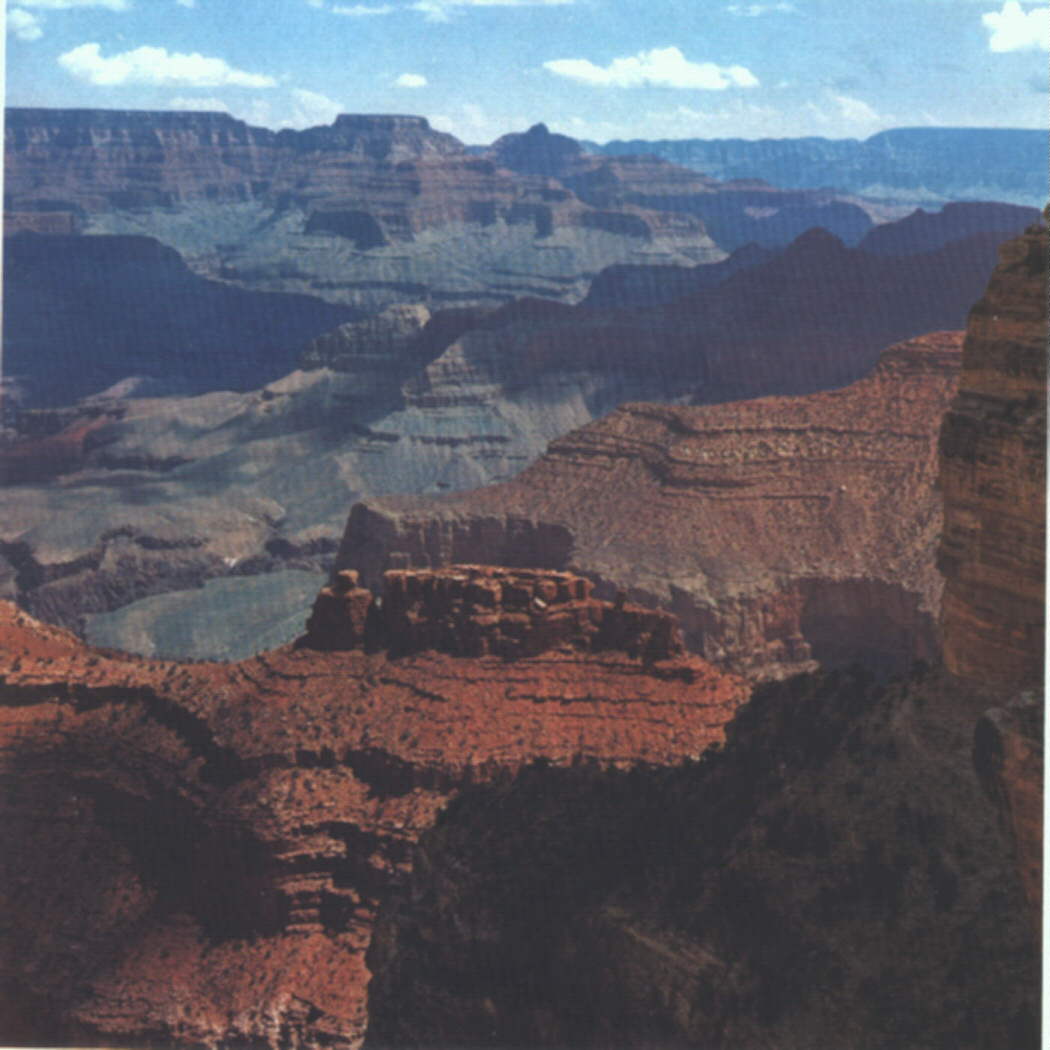
One of the truly astonishing and wonderful realities of Earth is that there are many, many stories written in it. In fact, there are so many stories as to dwarf our ability to comprehend them all. The sheer number of events recorded in rocks reveals stories that transpire through deep time, a time that has grown from the confines of our experience to be as immense and unfathomable as the rest of creation. There are stories of mountains where there are now seas, seas where there are now mountains, tropical jungle where there were once glaciers and glaciers where there were once tropical jungles. For the convenience of our finite minds, the immensity of geological time has been divided into periods.
ERA
PERIOD
Quarternary (Q)
Cenozoic
Tertiary (T)
Cretaceous (K)
Jurassic (J)
Mesozoic
Triassic (Tr)
Permian (P)
Pennsylvanian (P)
Mississippian (M)
Devonian (D)
Silurian (S)
Ordovician (O)
Paleozoic
Cambrian (C)
Precambrian (pC)
North Dakota has one of the simplest-to-read stories, because the rocks here are flat-lying and have not been greatly affected by mountain building events that have affected other parts of the country. Because of oil interests in the western part of the state, subsurface layers of rock have been extensively explored by drilling. Consider the stratigraphic column of Western North Dakota (~ 3 minutes to load at 14.4K baud) and try to spot the rocks that indicate the coming of seas, or their retreat. Consider how many different events have happened just here in North Dakota where things have been geologically quiet.
Stratigraphy deals with stories and sequences of events. It does
not deal directly with how long these stories took to transpire.
However, when these stories began to be read in the early 1800's, it was
clear to most people who read them that they must have taken an immensely
long period of time. However, it was not until the discovery of radioactivity,
and its use as geological clocks, that confident ages of rocks and ages
of events could be determined. (Activity
and puzzle to illustrate how radioactive dating works, est2b5.html).
Alternate Stratigraphy and Plate Tectonics Lab
Activity, considering predictions as a way to test theories.
Home Page (est.htm)
Previous Page (est2.htm)
image credit: unknown.