Earth Science Today, Stratigraphy and Plate Tectonics Activity, considering predictions as a way to test theories. (70 minutes)
Part 1:
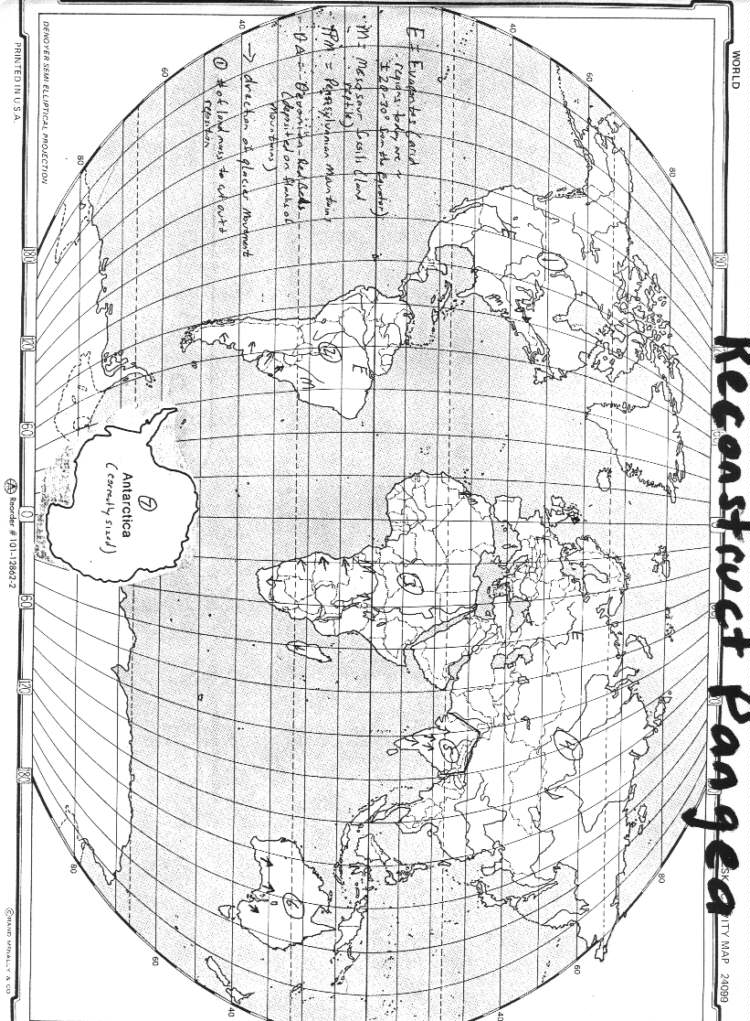
Step 1. Reunite Pangea! Cut out the 7
numbered land masses and, based on the evidence provided, reconfigure
them on a separate map. You need to use clues such as where mountains
are found, where arkose (red bed) is found, the shapes of the land masses,
which areas of land masses were at specific latitudes (considering the
clues in evaporites and glaciers), and the direction that glaciers moved
(they certainly didn't come up out of the ocean, but flowed toward the
ocean off of land!). The notes written on the map are essential clues
to doing this lab.
Step 2: The test of a theory is found in the ability to make predictions based on that theory that are shown to be true. Make a scientific prediction, based on plate tectonic theory, which can be tested by observations in the real world. Be specific. For example, one prediction is this: If plates have moved through time, then their orientation relative to Earth's magnetic north pole will have changed and so the magnetic orientation of old rocks will not be lined up with the modern North Pole. This has been tested and shown to be true. The goal here is to think of a prediction, think of a SPECIFIC way to test that prediction (something to look for, for example), then ask me what the results of your test would be if done.
Description of prediction How test prediction Results of test (ask me!)
Part 2. A claim is made that there was plate convergence
in the New England area in the Ordovician (North America was colliding
with another plate).
step 1: Make a prediction of the type of stratigraphy
that would result from this collision considering areas in Vermont and
New York to the West of the collision (presume that the continent was covered
by sea before the beginning of plate convergence and the sea retreated
and then sediment from the mountain flanks was deposited over the area).
Prediction of stratigraphy:
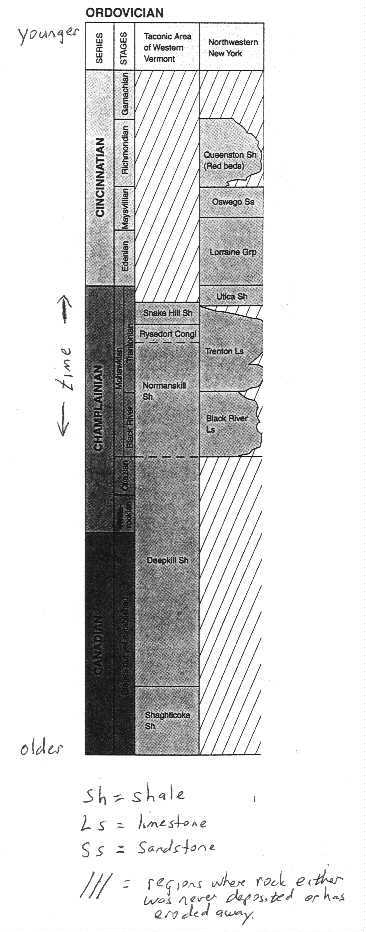
step 2: Examine the actual stratigraphy
of Northwestern New York as a test of your prediction (source: Earth
Through Time by Hal Levin). Does the actual stratigraphy support
the claim that convergence occurred? How?
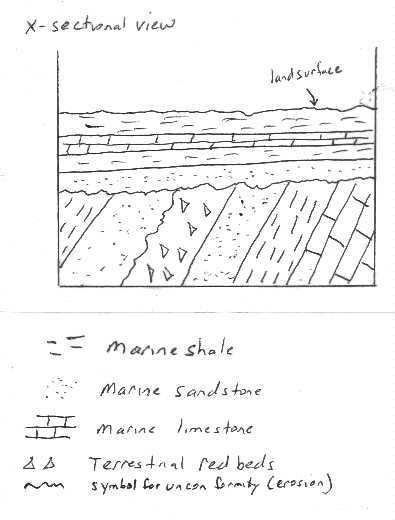
Part 3. Consider the cross-sectional
view of rock layers provided. There is evidence for several geological
events, including 2 advances of the ocean (marine transgression), 2 retreats
of the ocean (marine regression), tilting of rock layers, and 3 separate
periods of erosion. Put these 8 events in the order in which they
occurred (telling the story of the rock layers), with the OLDEST ON THE
BOTTOM.
__________________________________
__________________________________
__________________________________
__________________________________
__________________________________
__________________________________
__________________________________
__________________________________
Home Page (est.htm) Previous Page (est2b.html)