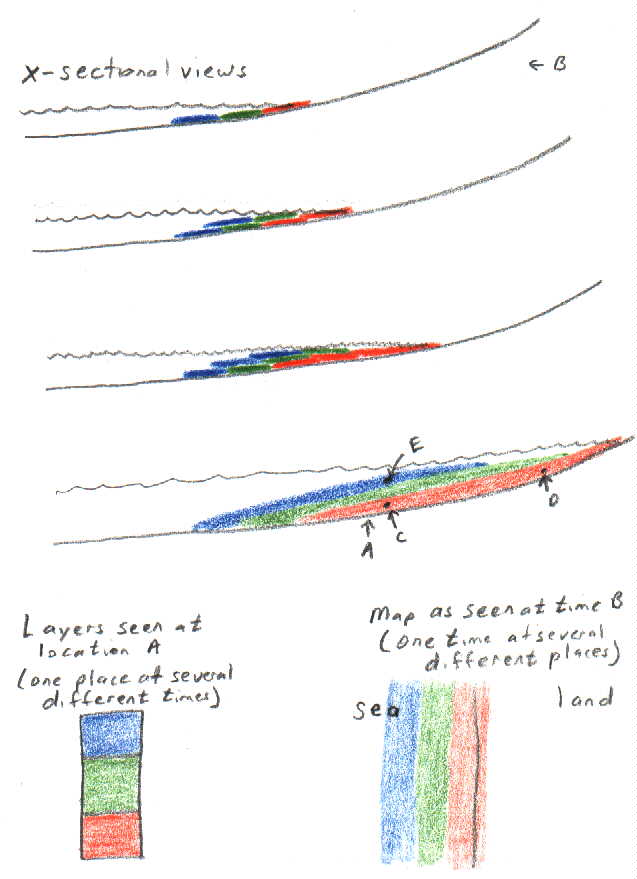
Clay stratigraphy activity, with illustration and puzzles:
The key concepts of stratigraphy can be understood through a simple
thought puzzle. Take three colors of modelling clay, say red for
sand, green for mud, and blue for limestone. Make a red strip for
the near-beach area, a green strip for the muddy area, and a blue strip
for the limestone. Notice that we don't have a layer of sand,
rather we have a strip of sand. Yet we observe that rocks
such as sandstone occur in layers. Why are rocks in layers?
Layers happen because environments move through time. Stratigraphy
is about thinking in 4 dimensions, the fourth dimension being time.
Imagine the ocean advancing, such that the beach environment moves to a
new location, the muddy environment overlaps where the beach used to be
and so on. Continue this, allowing the ocean to continue to advance.
You will generate a series of layers of clay, with the sand layer (red)
being at the bottom, the mud layer (green) in the middle, and the limestone
(blue) at the top. This activity illustrates how layers of rock develop,
and how layers reveal changes through time.
Puzzles:
Which is older, the rock at C or the rock at E or are they the same
age?
Which is older, the rock at C or the rock at D or are they the same
age?
(answers)
Home Page (est.htm)
Previous Page (est2b.html)