How can we explain ancient mountains, and mountains in the middle of continents (Urals)?
Lithospheric plates are consumed (subducted) at convergent boundaries
(in cases where ocean crust is involved, continental crust does not get
subducted), and new crust is created at divergent boundaries. Thus,
there is great capacity for the character of the Earth's surface to change
through time. Where convergence occurs, we can expect mountains.
Where divergence occurs, we can expect the formation or widening of seas.
Modern mountain ranges are in places where convergence is occuring (such
as the Andes, the Cascades, the Himalayas, the Caucasus, the Alps, the
island of Japan).
Ancient convergence explains the ancient mountain ranges.
Just before the age of the dinosaurs, Africa converged with North America
and made the Appalachian mountains. The Atlantic Ocean wasn't there
at the beginning of the age of dinosaurs when the great supercontinent
Pangea began to break up. The Atlantic has formed in the place where
North America and Africa have spread apart.
The Urals are the result of the convergence of two
ancient plates into one single plate (the Eurasian plate). An ancient
ocean once between those two plates closed, and, in fact, we can find pieces
of crust from the bottom of that ancient ocean caught up into the Ural
mountains.
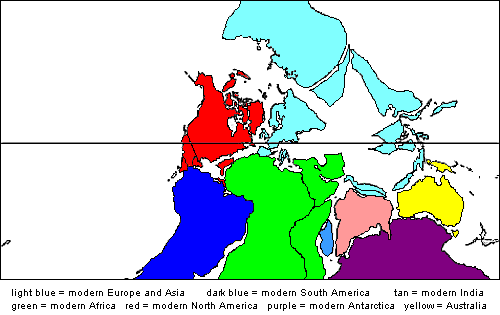
Map of continents at time of Appalachian
mountain building but before Ural mountains.
from www.dinosauria.com for 320mya.
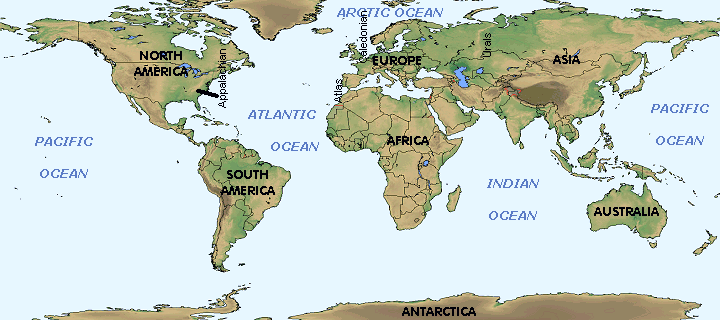
Map showing the modern location of some ancient
mountain ranges.
modified from unknown source.
Home Page (est.htm) Previous Page (est2b.html)