Earth Science
Today
Russ Colson
Minnesota State University
Moorhead
What kind of plate boundaries are possible and what are they like?
Adjacent plates can move
toward each other (convergent boundary)
away from each other (divergent boundary)
or
past each other (transform boundary)
Convergent boundary:
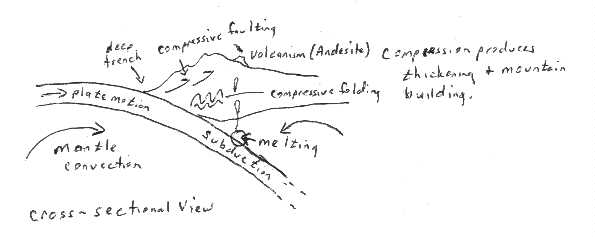
Modern examples:
ocean crust subducted beneath ocean crust:
Japan, Phillipines, Aleutian islands
ocean crust subducted beneath continental crust:
Andes, Cascades
Continental crust can also converge with continental crust. In
this case, there is no subduction and the geometry is different from that
shown in the picture. Modern examples include: the Himalayas,
the Alps.
Divergent boundary:
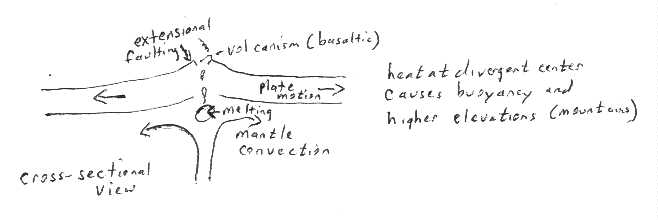
Modern examples: The mid-Atlantic ridge, the East African Rift,
the Red Sea and Gulf of Aden
Transform boundary:
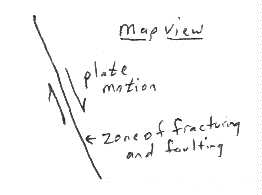
Modern example: The San Andreas Fault
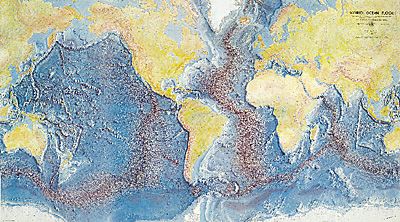
Image of the sea floor to show the locations
of volcanic islands, mountain ranges, and trenches associated with convergence
and subduction, and the mid ocean ridges associated with divergence.
In particular, the aleutian trench and the mid-Atlantic ridge are seen.
This image is copyrighted by Marie Thorp, 1977.
Home Page (est.htm)
Previous Page (est2b.html)