Western North Dakota:
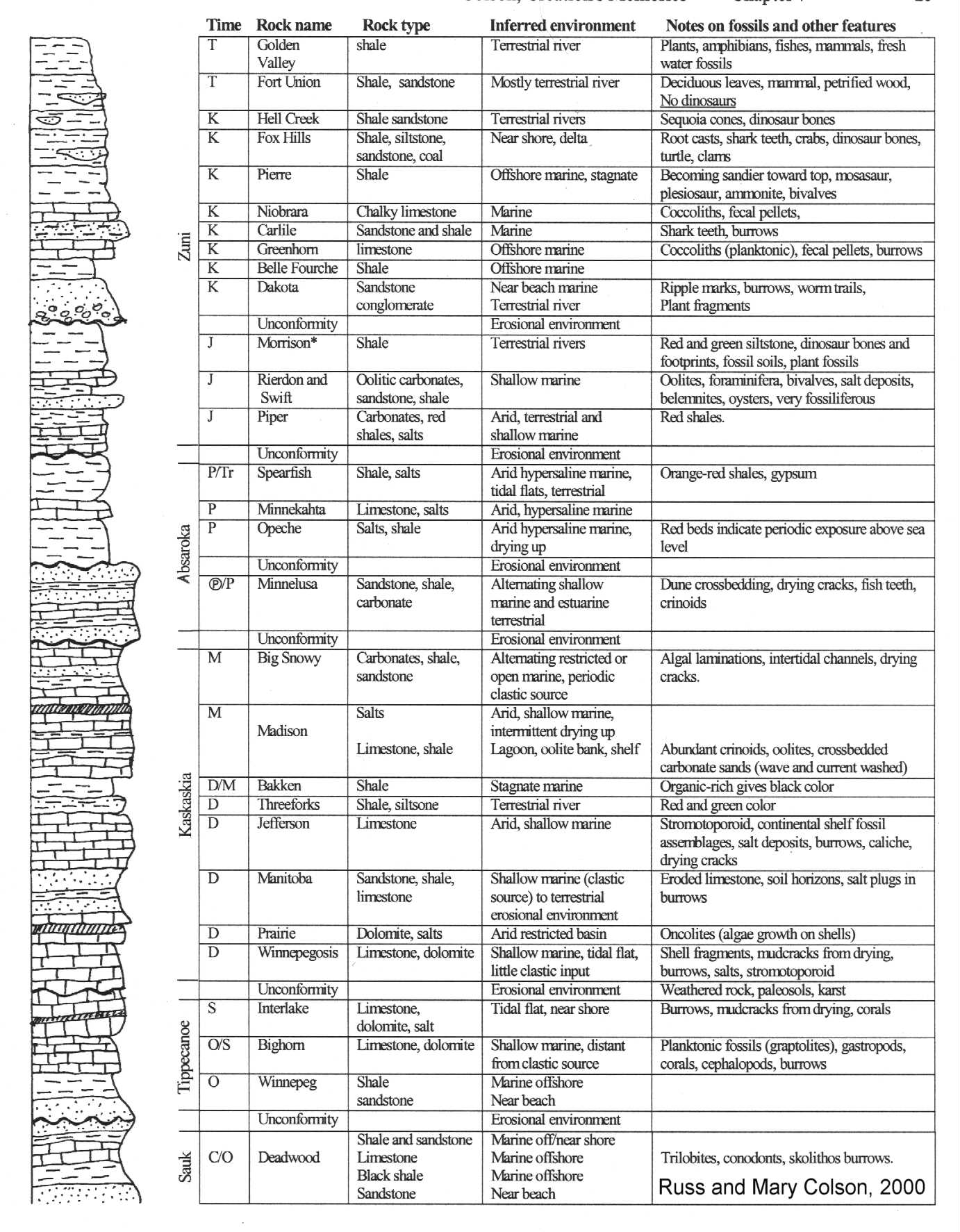
Stratigraphic Column of
Western North Dakota:
Notes for Stratigraphy of Western North Dakota.
Individual letters designate geologic periods of time:
C (Cambrian), O (Ordovician), S (Silurian), D (Devonian), M (Mississippian),
P in circle (Pennsylvanian), P (Permian), Tr (Triassic), J (Jurassic),
K (Cretaceous), T (tertiary), and Q (Quaternary).
The names Sauk, Tippecanoe, Kaskaskia, Absaroka, and Zuni,
refer to major depositional events in North America.
Relative thickness of rock units shown on this diagram
is arbitrary and does not represent actual rock thicknesses.
An unconformity is a buried surface between two bodies
of rock representing a break or hiatus in the record of geological events.
It is often marked by erosional topographic features (buried hills and
valleys), weathered rock, ancient soils (paleosols), or karst (caves weathered
in exposed limestone).
“Salts” refer to a variety of evaporite deposits,
including anhydrite, gypsum, and halite (table salt).
“Carbonates” refer to a variety of carbonate rocks, such
as limestone and dolostone.
“Clastics” refer to particles like sand or mud that have
usually been transported to a region of deposition, such as by wind or
rivers.
References include publications dealing with specific
rock units as well as the following: L. C. Gerhard, S. B. Anderson,
J. A. LaFever, and C. G. Carlson (1982) Geological development, origin,
and energy mineral resources of the Williston Basin, North Dakota, AAPG
Bulletin No 8, V 66, p 989-1020; L. C. Gerhard and S. B. Anderson
(1981) Oil exploration and development in the North Dakota Williston Basin:
1980 update ND Geol. Survey, Misc Series No 59, 19p.; J. P. Bluemle,
S. B. Anderson, C. G. Carlson (1981) Williston Basin Stratigraphic nomenclature
chart ND Geol. Survey Misc. Series No 61.; J. P. Bluemle (1991) The
face of North Dakota, Revised Edition, ND Geol. Survey Educational Series,
No 21, 177p.
* Although the Morrison is illustrated in Gerhard et al.
(1982) as being present in the subsurface of North Dakota, Bluemle (1991)
indicates that it has not been shown to be present there. We list
it here because it is shown in several of the cited references and because
it has been clearly identified across the border in Montana and South Dakota
and represents an important stage of the regional geological history.
Home Page (est.htm) Previous Page (est2b.html)