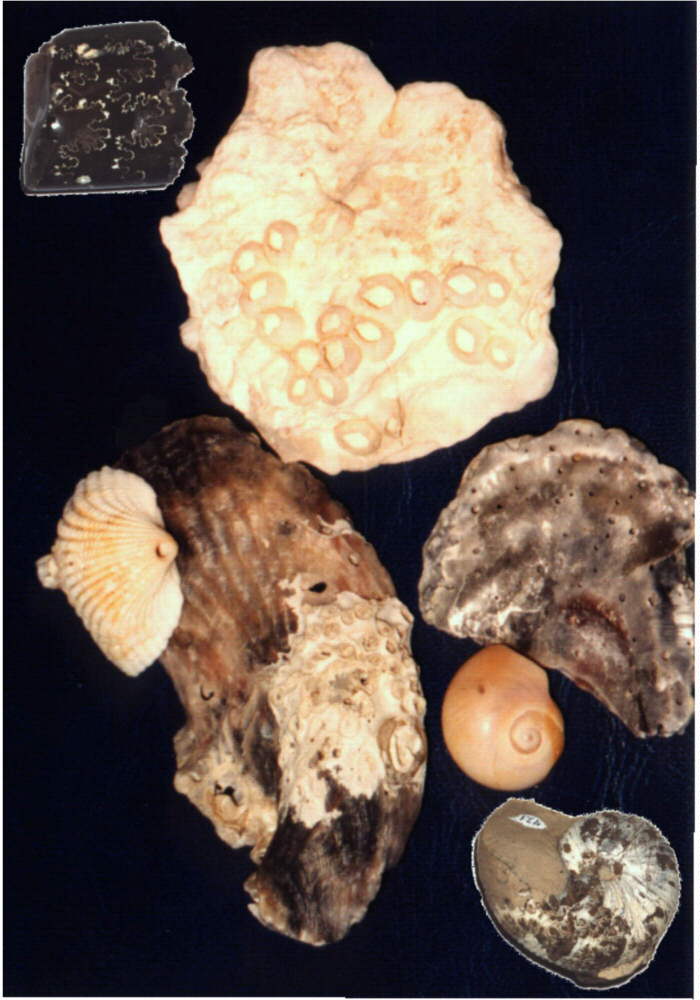
Earth Science Today
Russ Colson
Minnesota State University
Moorhead
Historical Geology:
Topic 1: Geological time and life of the past, reading stories in
rocks and fossils.
Often classification of rocks substitutes for geology. One
student
told me once "I always thought geology was just about rocks."
But,
in fact, geology is about telling stories, not knowing names of
rocks.
However, understanding the different types of rocks and how they form
is
crucial in knowing how to read their stories.
- Igneous Rocks: We learned about igneous rocks while
addressing
a previous topic. These are rocks that have formed by cooling
from
a molten state. Therefore, these rocks will tell a story about
melting
and cooling. The fact that it is an igneous rock reveals that it
got hot enough to melt. The size of crystals in it tell us how
quickly
it cooled. Fast cooling corresponds to cooling at or near the
Earth's
surface. Slow cooling corresponds to cooling deeper in the
Earth's
crust. Suppose we find a coarse-grained igneous rock at the
surface
of the Earth (the entire Sierra Nevada mountain range consists mostly
of
coarse-grained igneous rock). Think of the stories it
tells!
How did it come to be at the Earth's surface since we can see it must
have
cooled deeper in the Earth's crust? Suppose you find an igneous
rock
that is made mostly of crystal too small to see (it looks massive and
uniform),
but there are a few big, sparkly crystals in it. What story does
it tell? (answers, est2a1.html).
A table of some of the most common igneous rocks is shown below.
Grain
size
large
small
Composition
More
SiO2
granite
rhyolite
Less
SiO2
gabbro
basalt
- Metamorphic Rocks: Metamorphic rocks form as a
response to
changes
in temperature, pressure, or other parameters of the rock system.
In general, high temperature and pressure reflect deep burial, such as
in the roots of a growing mountain range, or exposure to an extra-hot
place
such as near a magma intrusion. Both the phase of the
rock
and the texture change in response to changes in the conditions
of the rock. Phase refers to the type of minerals found in the
rock
(think about the phase of water, which changes under different
conditions
of temperature or pressure to be either solid, liquid, or gas).
The
atoms of the rock reorganize into minerals which are chemically stable
at the new conditions of temperature, pressure, and other
parameters.
Texture refers to the size and orientation of the minerals in the
rock.
In general, minerals grow larger with increasing temperature, pressure,
and duration of metamorphism. In addition, flat, plate-like
minerals
become aligned like sheets of paper stacked all together. This
orientation
is called foliation. A table of
some common metamorphic rocks is shown below.
Type of rock that is
metamorphosed
shale
sandstone
limestone
degree of metamorphism
low
slate
quartzite
marble
medium
schist
quartzite
marble
high
gneiss quartzite
marble
Thought Puzzle: You find a gneiss at the top of a large
mountain.
What story does it tell us of the past? (answer,
est2a3.html)
- Sedimentary Rocks: Sedimentary rocks are ones that
have
formed
by the weathering of preexisting rocks (chemical and mechanical
breaking up of sedimentary, igneous, or metamorphic rocks) to form
sediments
that are transported (moved by wind, rivers, ice, or other
means),
and deposited (when the wind or river, for example, becomes too
slow to carry the sediment further and it settles out), and then lithified
(minerals, often deposited out of pore water, cement the sediment
grains
together to make a new rock). Sedimentary rocks tell us about
past
environments at Earth's surface. Because of this, they are the
primary
story-tellers of past climate, life, and major events at Earth's
surface.
Each type of environment has particular processes that occur in it that
cause a particular type of sediment to be deposited there. This
can
be illustrated by a simple experiment. Think about putting a pile
of mud, sand, and gravel in a pile on one side of a plastic basin, and
putting water at the other side. Gently slosh the water against
the
"shoreline" of the mud, sand and gravel (making waves). Do this
for
a while. What happens? (answers,
est2a4.html).
This simple experiment illustrates the key way that many sedimentary
rocks
tell stories: The size of particles reveals the energy present in
the environment of deposition. Think of this other example:
Fast mountain rivers have gravel in them because smaller sand and mud
is
washed away. Slow meandering rivers often have mud in them
because
the slow water allows the mud (clay and silt) to settle out.
Water,
ice, and wind each carry sediment in a different way, with water and
wind
sorting the sediment out by size according to the speed (energy) of the
water or wind, whereas ice carries sediment indescriminately, resulting
in an unsorted mixture of gravel, sand, and mud which we call glacial
till.
Finding an unsorted sediment or rock can therefore be a clue to a
long-vanished
glacier. Finding shale (made of tiny clay and silt particles, try
scraping them off with a knife to see the powder that forms) is a clue
to a body of very quiet water with little movement, like a deep lake or
an ocean distant from the waves.
We can also interpret
sedimentary
rocks by considering the concept The Present is the Key to the Past.
For example, if you find a sandstone, where might that rock have
formed?
Where do you find sand today? (beaches, rivers, dune deserts for
example).
If you find coal, made of abundant plant material that has accumulated,
consider what kind of environment we find plant material accumulating
in
today (swamps and bogs for example). By comparing the rocks
we see with modern environments, we can figure out what type of
environment
that rock formed in. By considering details of the rock, such as
the texture (how the grains fit together and their size) and structures
in the rock (cross-bedding of layers, ripple marks, etc) and comparing
these to the textures and structures in modern sediments, we can
identify
more details about the environment that a rock formed in.
Some sedimentary rocks form not by
deposition
of particles carried by water, wind, ice etc. (called detrital rocks)
but
rather by crystallization from water (chemical sedimentary
rocks).
For example, table salt is mined from rock halite, a rock deposited as
water becomes very salty (such as when sea water evaporates).
Such
a rock tells the story of a body of sea water that has restricted
access
to fresh sea water (which would dilute the water and prevent salt from
crystallizing) and possibly arid or hot conditions.
Detrital rocks:
particle size too small to see
sand sized particles pebbles sized
particles
Shale
sandstone
conglomerate
Chemical rocks:
rock halite (NaCl),
rock
gypsum, limestone
Biochemical rocks (crystallization or formation aided by living
things):
limestone (mostly
CaCO3), coal (mostly C).
- Fossils: Fossils are not found willy-nilly all mixed
together
in peculiar rocks as though simply dumped there by aliens from
space.
Rather, fossils are found together with other fossils and rocks in
groupings
that make sense in terms of the living communities we see in modern
environments.
For example, some types of creatures are suspension feeders, meaning
they
eat
by extracting particles of food suspended in the water. Their
"filtering"
apparatus
would be quickly overwhelmed and plugged in muddy water, thus, in the
modern
world, we find these creatures in clear, clean water. Likewise,
in
ancient rocks, we see communities of creatures and rock types with the
suspension feeder fossils that suggest clear, clean water.
Fossils also give us clues to past
climate.
Polar bear fossils (or their equivalent from the geological past) tell
us about cold climates. Coral often tell us about tropical
climates
(this is because CaCO3 which coral make their homes out of is more
easily
dissoved in cold water, thus making cold water less hospitable to
them). Some species of coral (made of CaCO3) have a higher
concentration of Sr if the sea temperature was higher.
There are many things which the features of a
fossil can reveal about the environment the creature lived in.
For
example, the thickness of the shell of a bivalve (sea shell) can reveal
wether the environment was quiet or turbulent (a thick shell would be
needed
to survive a turbulent environment).
One of the most significant questions about an
environment is whether it was marine (ocean) or terrestrial (rivers,
lakes,
etc). The type of creature can reveal whether water was
fresh
or marine (think about walleye vs sharks). Fossils can reveal
whether
there was nearby land. For example, petrified wood indicates the
presence of trees which don't grow out in the middle of the
ocean.
Also, all dinosaurs were terrestrial and are found mostly in
terrestrial
rocks although sometimes in marine rocks where they got washed out to
sea.
The number of fossils (abundance) and the
variety
of creatures (diversity) give clues to the environment as well.
Abundance
indicates an abundance of food in the environment, diversity indicates
that the environment was stable (because large variations in
temperature,
salinity, oxygen etc create conditions that only a few types of
creatures
can survive in). It is interesting that there is a similar
relationship
present in human societies. Where resources are abundant, there
are
more people (in general), where conditions are stable, people become
increasingly
specialized in their work.
Thought puzzle: You find two rocks. One is a
limestone
containing fossil crinoids (a filter feeder) in great abundance, along
with many other types of fossils. The other is a very
fine-grained
gray shale with black imprints of willow leaves in great
abundance.
What can you say about the ancient environment in which these rocks
formed?
(answer, est2a5.html)
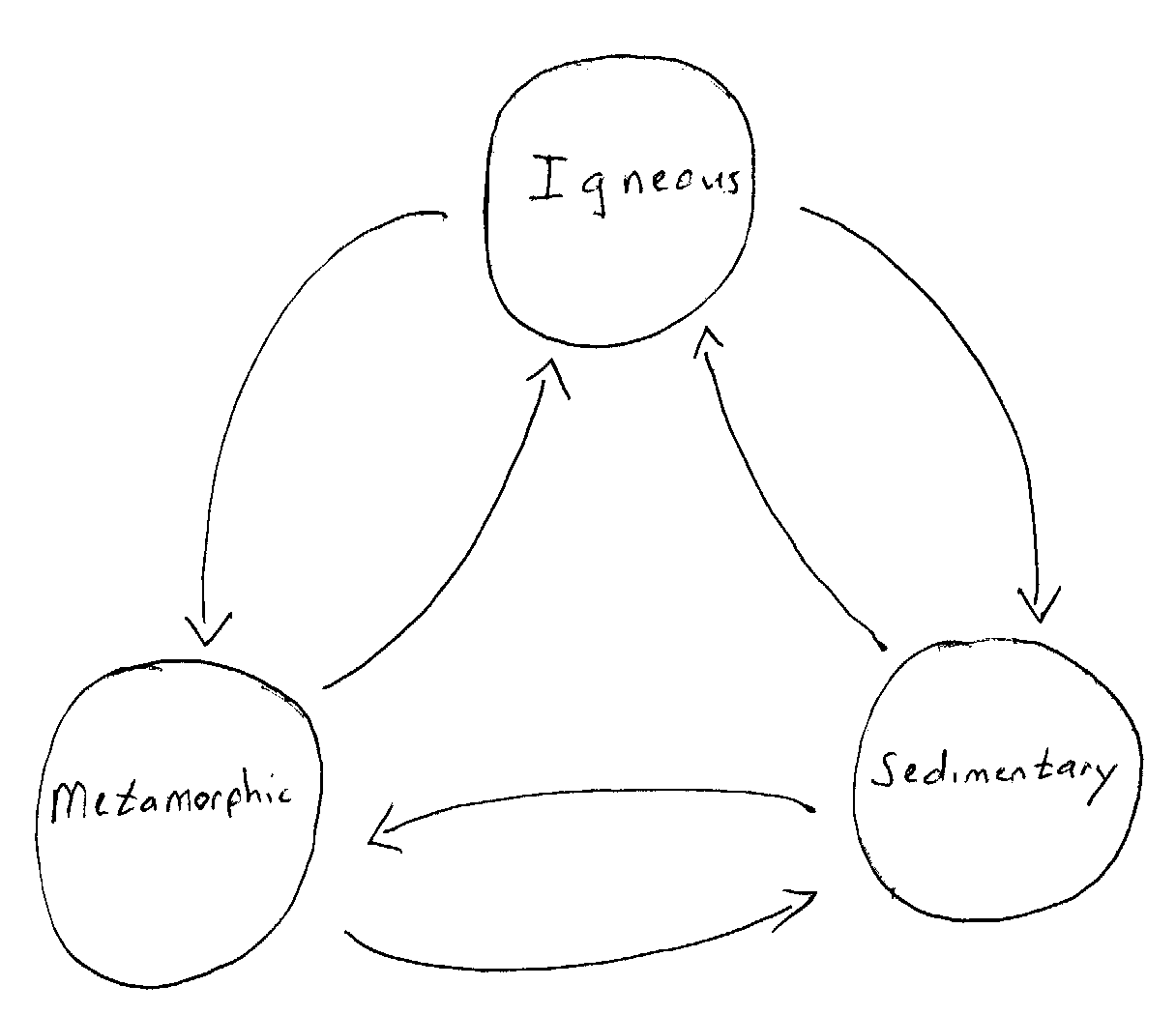
Rock Cycle puzzle: knowing the processes by which each type of
rock forms, and knowing that one rock is changed into another rock
through
geologic time, you can complete the following schematic diagram of the
Rock
Cycle. In each circle, I have written the name of a type of
rock.
On each arrow write a process by which one rock can be changed into
another
rock. (answer, est2a6.html)
Lab Activity: Rocks and
stories
they tell (in MSWORD)
Lab Activity: Invertebrate fossils. (in
MSWORD)
A dinosaur identification activity is
available in MSword.
Also, a 12-15 hour unit sediment stories
activity for kids age 9-14 is available in MSword.
This unit teaches kids about how to read the stories written in simple
sediments and sedimentary rocks.
Home Page (est.htm) Previous
Page (est2.htm)