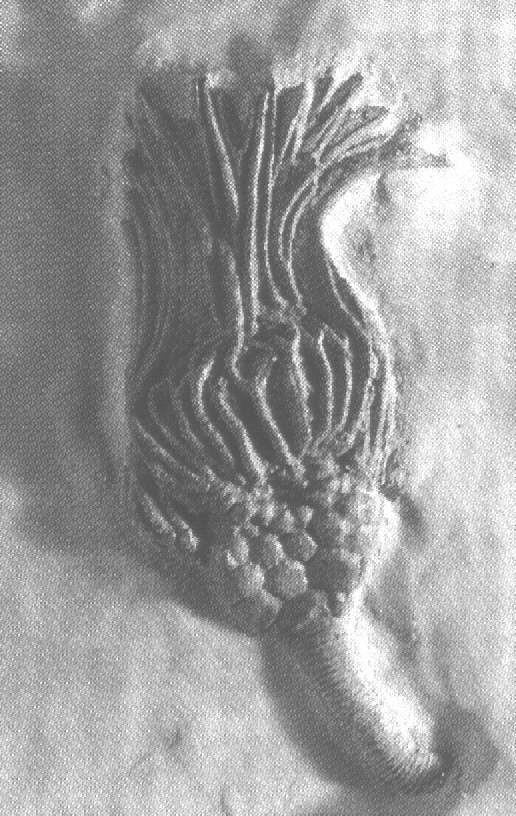
 Crinoid calyx
Crinoid calyx
Thought puzzle: You find two rocks. One is a limestone containing fossil crinoids (a filter feeder) in great abundance, along with many other types of fossils. The other is a very fine-grained gray shale with black imprints of willow leaves in great abundance. What can you say about the ancient environment in which these rocks formed?
Rock 1: This rock is limestone (CaCO3) suggesting it may have
formed in warm water (since CaCO3 dissolves more easily in cold water).
The crinoids are filter feeders, suggesting the water was clear and clean.
Also, if there was lots of mud or sand around, we would have a shale or
sandstone instead of a limestone, also suggesting clear, clean water.
The abundance of crinoids also suggests abundance of food (the ultimate
food source is the sun, so to some extent this also suggests the possibility
that the water was warm and tropical). The diversity of creatures
suggests stability of environment (little variation in temperature, saltiness,
etc). This also suggests a tropical location, because the seasons
of Earth cause larger variations in water temperature in temperate versus
in tropical seas.
Be aware that this evaluation has been simplified
to use the qualitative, general principles that we are learning in this
course. In an actual paleoenvironmental study, the specific types
of creatures and specific sediment types would be examined to see if they
fit with this general indication of environment. In real life, we
do sometimes get limestone forming in colder water, or a diversity of creatures
in unstable environments.
Rock 2: This rock is fine grained (shale), suggesting that there
was little movement, churning, or stirring of the water. It must
be either deep water where waves don't churn it (like a deep lake or sea)
or too limited in scope to generate many waves (like a lagoon). The
presence of willow leaves reveals that it must be terrestrial (river, lake,
lagoon). The type of leaf (willow) and their abundance also suggests
that the climate must have been wet. We thus conclude a standing
body of water in a rainy, terrestrial environment.
Home Page (est.htm) Previous Page (est2a.html)