Earth Science
Today
Russ Colson
Minnesota State University
Moorhead
Suppose we find a coarse-grained igneous rock at the surface
of the Earth (the entire Sierra Nevada mountain range consists mostly of
coarse-grained igneous rock). Think of the stories it tells!
How did it come to be at the Earth's surface since we can see it must have
cooled deeper in the Earth's crust? Suppose you find an igneous rock
that is made mostly of crystals too small to see (it looks massive and
uniform), but there are a few big, sparkly crystals in it. What story
does it tell?
The rock of the Sierra Nevada must have cooled at depth in the Earth's
crust, then been exhumed to the surface in some way. The process
which we can observe happening today that might exhume something from depth
is erosion. Thus, we infer that erosion of formerly overlying rock
has raised the coarse grained igneous rock to the surface.
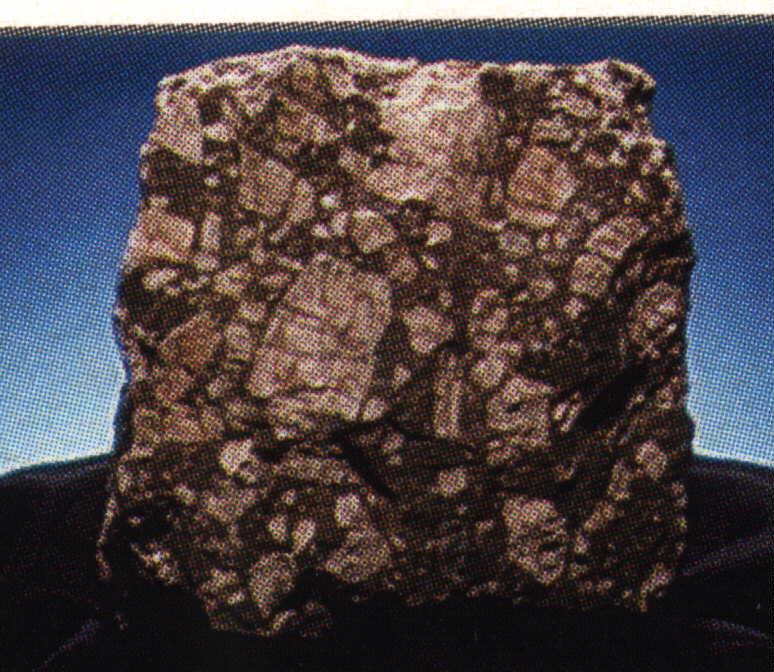 Porphyritic
Trachyte (2 crystal sizes)
Porphyritic
Trachyte (2 crystal sizes)
Two different sizes of crystals in an igneous rock imply two different
rates of cooling. There was an initial cooling stage at depth in
the crust when the magma cooled slowly, growing large crystals. Then,
when the magma was a mush of large crystals and still-molten material,
it erupted to the surface and cooled quickly, leaving the big crystals
imbedded in a matrix of small crystals.
Home Page (est.htm)
Previous Page (est2a.html)