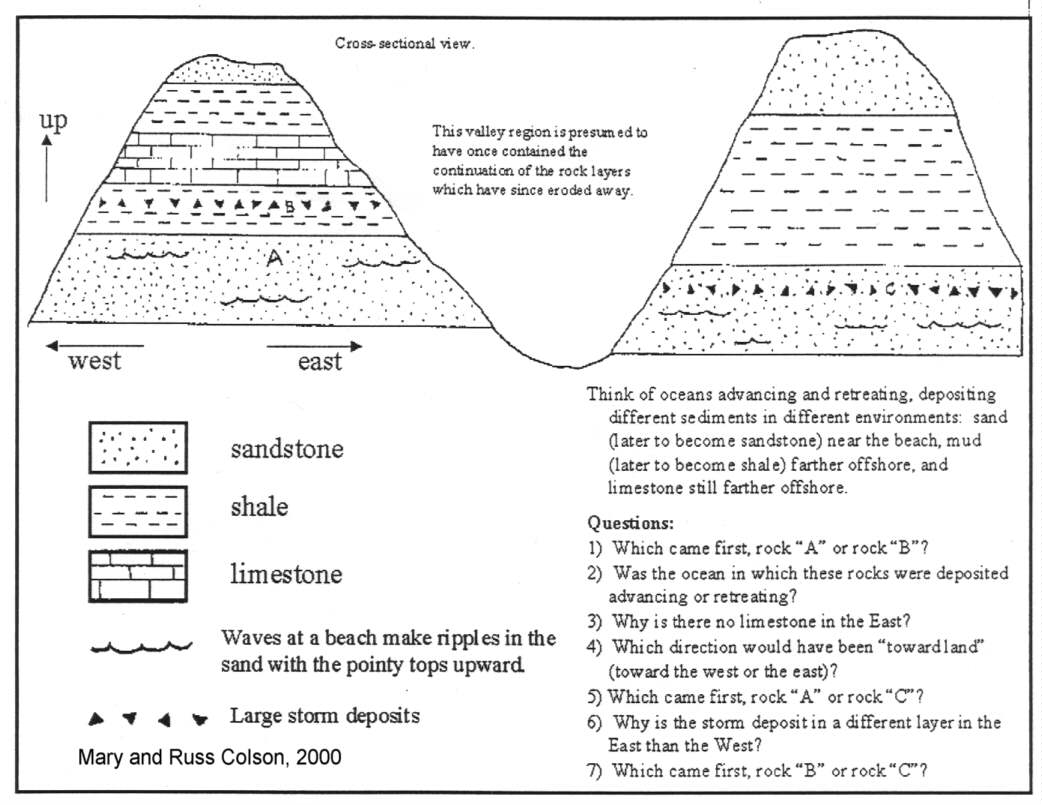
Answers to Stratigraphy Thought Puzzle:
1) Rock A came first. It is on the bottom, and we can tell from
the ripple marks with the pointy tops pointing upward that this rock has
not been tilted upside down. From the principle of superposition
we infer that the lower layer had to be there when the sediments of the
upper rock were deposited.
2) The ocean advanced (limestone on top of shale on top of sandstone)
then later retreated (sandstone on top of shale on top of limestone).
On the hill on the East we don’t see the limestone but we still see evidence
of the same marine transgression (shale on sandstone) and regression (sandstone
on shale).
3) The limestone only occurs farther from land. Presumably the
sea never advanced far enough for the limestone to occur in the East.
4) Land was in the East, since the limestone, indicating an environment
farther out to sea, only occurs in the West. In actual practice,
this inference would need to be confirmed by other evidence, such as sand
in a same-age layer getting coarser Eastward. Present elevation differences
can’t be used to indicate former land slope (see comments for question
7 below).
5) Because the sea was advancing from West to East (see 2 and 4 above),
the sandy near-beach environments arrived at point A prior to point C.
Thus, rock A is older than rock C.
6) A big storm would occur all at once in both places. But at
that moment in time, the ocean beach was in the East and a muddy-bottomed
sea in the West. Thus the storm affected different types of sediments
in those two areas.
7) Since the storm deposit represents a geological “moment” (see 6
above), B and C are the same age. The present elevations do not in
general reflect past elevations because tilting, uplift, and faulting change
the relative elevations. So elevations can’t be used to indicate
relative age, although stratigraphic position can be used.
Home Page (est.htm)
Previous Page (est2b.html)