Earth Science Today
Russ Colson
Minnesota State University
Moorhead
Answers:
Consider two storms in the vicinity of Fargo-Moorhead (FM), storm #1
and storm #2, which move progressively toward the northeast (as marked
by time-steps L1, L2,
and L3). In which case would the
wind be a backing wind, and in which case would it be a veering wind?
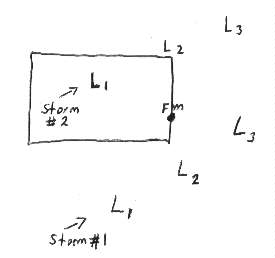
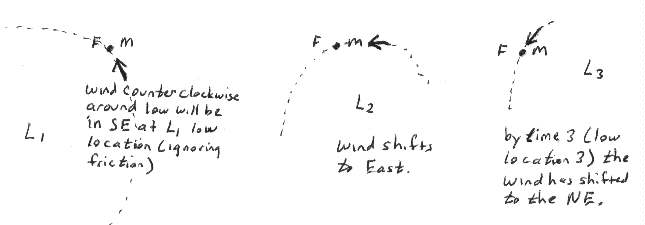
As storm #1 passes to the south of F-M, the wind will shift from
the southeast (at the time the low is at location L1), to the east (at
the time the low is at location L2), to the northeast (at the time the
low is at location L3). This can be illustrated as shown below.
By the same reasoning, the winds at F-M for storm #2 will begin in
the southwest, shift to the west, and then to the northwest, a veering
wind.
The storm track for storm #1 brings the northwest quadrant of the
low over the F-M area. Since the strongest part of a winter storm
is often in this quadrant, this is the scenario mostly likely to produce
severe winter weather. Thus, a backing wind is the one that
often accompanies stormy weather.
Home Page (est.htm)
Previous Page (est4a4.html)