
Historical Geology:
Test Structure:
Minnesota teacher licensure standards require all elementary teachers
to know and apply the fundamental concepts and principles
of earth and space science. Quizzes are in two parts, the first
part to measure knowledge, the second to practice and test your application
of that knowledge. In general, the application questions are
harder than the knowledge ones. Knowledge questions will comprise
about 60% of each quiz, application questions about 40%.
K-6 Content Knowledge Standards Covered:
Standard: Understand the
Properties of Earth Materials
1) Know
what the properties of rocks, such as particle size and texture, tell us
about how the rock formed. This includes properties of igneous, metamorphic,
and sedimentary rocks.
2) Know what fossils tell us about past environments.
Standard: History of the
Earth
1) Understand
how to use properties of rocks to "read" past events on Earth.
2) Understand how layers of rock tell stories of changes in the Earth and its environments through time, and how to "read" those stories in the rock layers..
3) Know the geological time periods of Earth.
Standard: Know the structure
of the Earth System
1) Know
how the Earth's lithosphere is divided into plates.
Standard: Understand changes
in Earth and sky
1) Understand
how movement of lithospheric plates, with divergent regions and convergent
or subducting regions, change the surface of the Earth, producing many
features we see on Earth, such as volcanoes, earthquakes, mountain ranges,
deep ocean trenches, and rift valleys.
2) Understand how processes of formation can change one rock into another. For example, melting and crystallization of a sedimentary rock produces an igneous rock. Weathering, redeposition, and lithification of an igneous rock produces a sedimentary rock.
Example Test Questions for Knowledge Part
1) List the Eons of time after preCambrian (there are 3 of them). Put the oldest on the bottom and the youngest on the top.
2) When trying to identify how fast some ancient and long-vanished
river was flowing we might look at
a) The size of particles in a sedimentary rock
b) The size of particles in an igneous rock
c) The character and minerals in a metamorphic rock
d) How much Nickel is present in Earth's core
3) Draw layers of rock that clearly portray what might be expected if an ocean first advanced, then retreated over a region.
Example Test Questions for Application Part
1) With NOT MORE THAN 1 sentence or 2 handwritten lines, give one specific example of how a fossil tells something about past environments and what it tells.
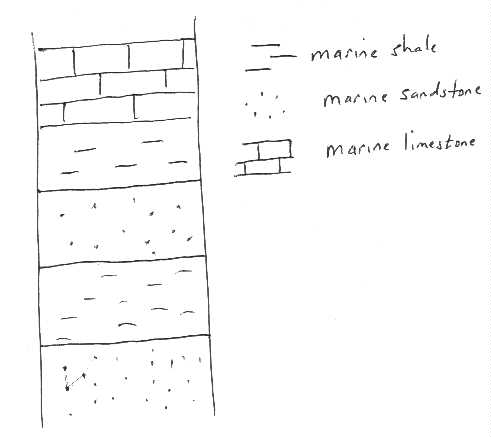
2) Given the stratigraphic column shown, put the following in
correct order with the oldest on the bottom (one of this list of 4 did
not occur and you should list only 3 of them): Marine regression,
marine regression, marine transgression, marine transgression.
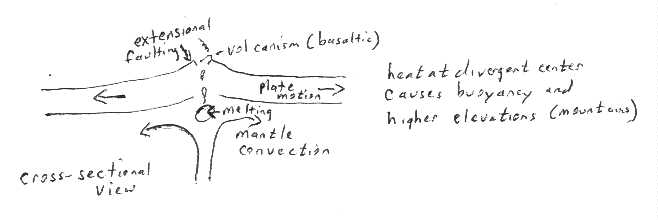
3) Draw a cross-sectional view of a divergent boundary, showing any volcanism, faulting, movement, convection in the mantle, subduction, trenches, and mountains.
Answers to Application Questions:
1)
wrong or weak answers:
Fossils tell us about the past and the kind of climate that existed
back then.
(too vague and does not give a specific example)
Filter feeders fossils happened and they prove that it was clean.
(poor writing. What was clean?, "prove" too strong without explanation,
"happened?")
Strong answer:
Because the amount of Mg in sea shells
increases with decreasing water temperature, the amount of Mg in CaCO3
fossils can be a good indicator of ancient ocean water temperature.
2)
Marine transgression
Marine regression
Marine transgression
2nd regression event did not occur in these rocks.
3)
Home Page (est.htm)
Previous
Page (est2.html)